

RTA Kitchen Cabinets: What You Should Know Before Buying Them
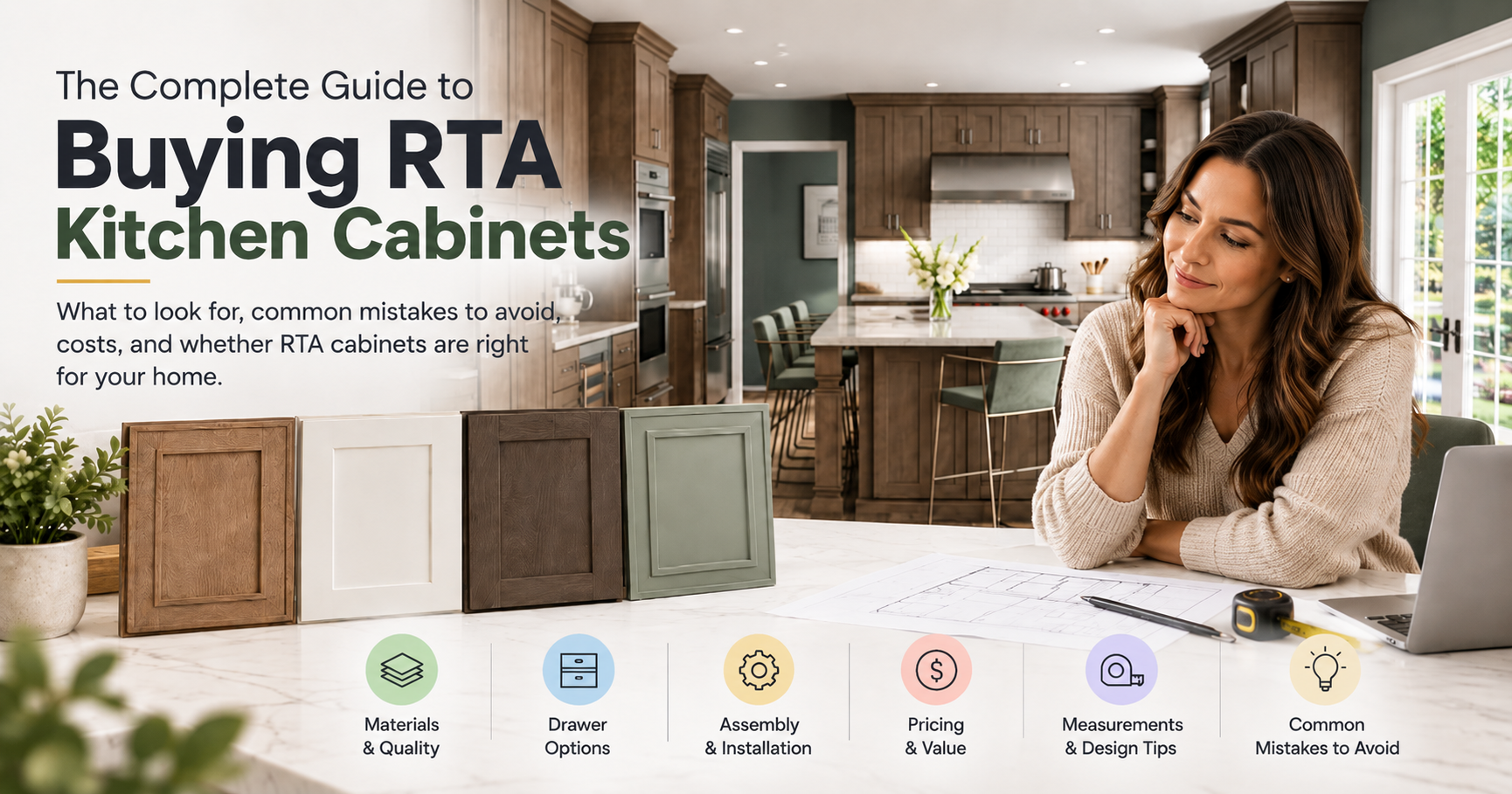
If you are shopping for new kitchen cabinets, there is a good chance you have come across the term RTA cabinets.
RTA stands for Ready to Assemble. Instead of arriving as a fully assembled cabinet, the cabinet components are packaged flat and assembled before installation.
That sounds simple enough. But there is one important thing we wish more homeowners knew:
There are inexpensive RTA cabinets made with basic materials, and there are RTA cabinets built with plywood boxes, solid-wood drawer boxes, dovetail joints, full-extension undermount glides and soft-close hardware.
The same is true of assembled cabinetry. A cabinet arriving already assembled does not automatically make it better.
So if you are comparing kitchen cabinets, don't start by asking:
“Is it RTA?”
Start by asking:
“How is this cabinet actually built?”
This guide walks through what we recommend looking at before buying RTA kitchen cabinets, what can easily get overlooked during a kitchen renovation, and what we've learned from helping homeowners plan kitchens here at Walnor Cabinets.
What Are RTA Kitchen Cabinets?
Ready-to-assemble kitchen cabinets are manufactured as individual cabinet components and packaged for assembly before installation.
Depending on the cabinet line, assembly might involve locking components together, metal clips, interlocking joints, screws, glue or a combination of methods.
The biggest difference between RTA and assembled cabinets is therefore not necessarily what you see after installation.
It is where part of the assembly labor happens.
With RTA cabinets, that work is completed after the cabinets arrive. With assembled cabinets, it has already been completed before delivery.
Flat-packed cabinets can also occupy less space during transportation and storage than assembled cabinets.
That can contribute to the affordability that makes RTA cabinetry attractive, but it shouldn't be confused with lower quality.
RTA does not mean particleboard
This is one of the biggest misconceptions about the category.
RTA cabinets can be manufactured from plywood, particleboard, MDF and other engineered materials. Construction specifications vary significantly from one cabinet line to another. Current RTA products on the market demonstrate that variation clearly, with different products using different box, shelf, door and drawer materials.
That is why comparing cabinets based on the letters “RTA” alone doesn't tell you much.
You need to look inside.
7 Things to Check Before Buying RTA Cabinets
1. Start With the Cabinet Box
The cabinet box is the structural body of the cabinet.
Ask the seller specifically:
What is the cabinet box made from, and how thick is it?
Plywood is generally desirable in kitchen cabinetry because its layered construction provides good structural strength, screw-holding capability and resistance to the moisture conditions commonly found in kitchens. Particleboard can also be used in cabinetry, but prolonged exposure to moisture is a greater concern.
Our cabinet interiors have a natural-stain finish and adjustable shelving. Depending on the supplier, shelves may use metal clips or heavy-duty plastic clips. The shelves are approximately three-quarter depth rather than running the entire cabinet depth.
But even if you aren't shopping with Walnor, the lesson is the same:
Ask for the specifications.
Don't accept “all-wood construction” or “premium construction” without finding out what those terms actually mean.
2. Open the Drawer
One of the easiest places to evaluate a cabinet is somewhere homeowners sometimes overlook:
the drawer box.
Look at how the corners are joined.
Dovetail joinery uses interlocking joints rather than simply relying on stapled corners. It is commonly used as a quality feature in cabinet drawer construction.
Then look underneath the drawer.
Ask whether the glides are:
Soft-close
Full-extension
Undermount or side-mounted
Full-extension glides allow the drawer to extend farther for access to items stored toward the back. Undermount glides keep most of the hardware underneath the drawer rather than visible along its sides.
They also include soft-close, full-extension undermount drawer glides across the styles we carry.
Hardware manufacturers can vary by supplier; DTC hardware, for example, is used on some Walnor styles.
This is an important distinction when comparing quotes.
Two kitchens can look very similar in a rendering while having noticeably different construction underneath.
3. Check the Hinges Too
Soft-close shouldn't stop at the drawers.
Check the cabinet doors and ask whether soft-close concealed hinges are standard or an upgrade.
We also carry framed cabinets with full-overlay doors.
Full overlay means the doors and drawer fronts cover most of the face frame when closed, leaving relatively little of the frame visible. Partial-overlay cabinetry leaves more of the face frame exposed.
Neither term should be confused with the quality of the door material itself, so that brings us to another important question.
What Are the Cabinet Doors Actually Made From?
The answer can vary even within the same cabinet company.
Most of our door styles have recessed center panels, with the slim-Shaker styles being exceptions.
Our stained cabinet doors use veneer finishes.
Why does this matter?
Because a cabinet should be evaluated as a collection of components.
The box material, face frame, door, drawer box, hardware and finish can all be different materials. A salesperson describing a cabinet simply as “wood” doesn't give you enough information to compare it with another product.
Ask for the components individually.
One of the Most Overlooked Questions: Are the Cabinet Sides Finished?
Imagine reaching the end of your kitchen installation and discovering that an exposed cabinet side doesn't have the finished appearance you expected.
Depending on the cabinet collection, an exposed end may already have a finished side or may require an additional skin or decorative end panel.
This is not universal across the RTA industry. Current cabinet programs differ in how finished ends are handled, which makes it something worth confirming before ordering.
That's why a good kitchen design should account for more than the cabinet boxes themselves.
Before approving your order, verify where exposed cabinet ends occur and whether your particular collection requires additional panels.
How Difficult Are RTA Cabinets to Assemble?
There isn't one universal answer because there isn't one universal RTA assembly system.
Dovetail construction
Components use interlocking joints. Glue may be recommended depending on the cabinet, although it isn't necessarily required.
Metal clip assembly
The cabinet components are secured using the cabinet's clip system. Again, glue may be recommended but is not necessarily required.
Three-spine construction
Components lock together through the cabinet's assembly system.
All three can produce a well-constructed cabinet when assembled correctly. Each has practical advantages and disadvantages during assembly.
Other manufacturers use still different systems. Some RTA instructions, for example, specifically call for glue, brackets and sliding dovetail joints.
That is why we don't recommend following a random RTA assembly video and assuming your cabinets work the same way.
Always use the assembly instructions for the cabinet line you purchased.
RTA vs. Assembled Cabinets: Which Should You Choose?
For many homeowners, this decision comes down to a simple question:
Do you want to pay for the assembly to be completed before the cabinets arrive, or are you comfortable having them assembled locally?
RTA can make sense if you or your installer are comfortable assembling the cabinets.
Assembled cabinets can make sense if you want to reduce the work required at the jobsite.
Our general delivery lead time is approximately:
RTA / unassembled cabinets: 7 business days
Assembled cabinets: 14 days
These are general estimates rather than guaranteed delivery dates. Availability, supplier inventory, location and the specific cabinet collection can affect timing.
Are RTA Cabinets Only for Budget Kitchens?
No.
Price and construction quality are two separate questions.
In our experience working in the cabinet industry, we've seen RTA cabinetry used in everything from budget-conscious renovations to very high-value homes.
Why?
Because homeowners don't necessarily want to spend more money simply because they can.
If a standard cabinet program provides the construction, appearance, layout and functionality a homeowner wants, there may be little reason for that homeowner to pay for fully custom cabinetry.
Where RTA becomes limiting is when the kitchen requires highly specialized customization that standard cabinet programs cannot provide.
For example, a project may require unusual dimensions, highly specific modifications, specialized finishes or architectural details that simply aren't available in a standard cabinet catalog.
That's where custom cabinetry starts to make more sense.
So the better question isn't:
“Is my house expensive enough for custom cabinets?”
It is:
“Does my kitchen actually require custom cabinetry?”
How Much Do RTA Kitchen Cabinets Cost?
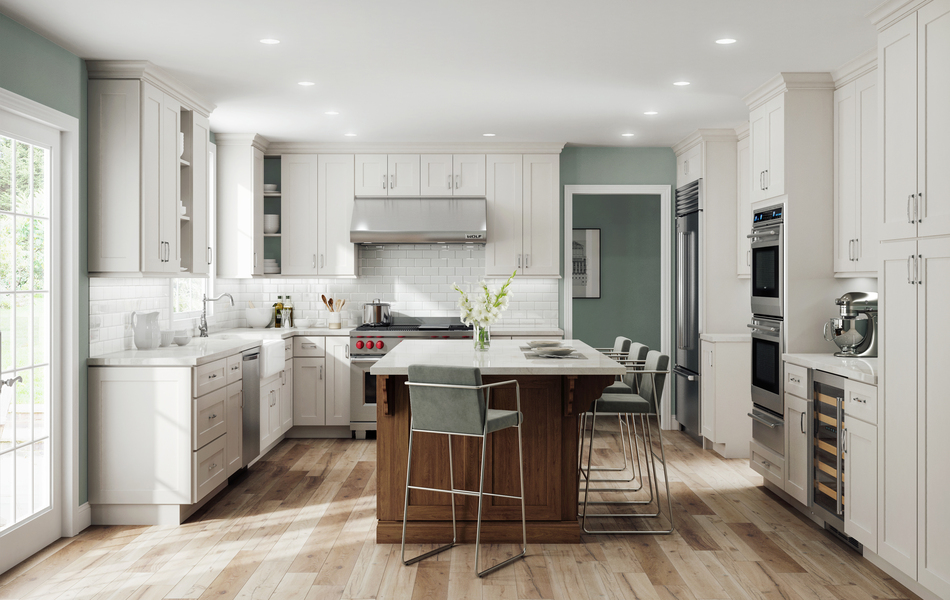
This is one of the hardest questions to answer online because “10×10 kitchen” pricing can become misleading very quickly.
Two kitchens with the same room dimensions can have very different cabinet configurations.
One may have basic wall and base cabinets.
Another may have drawer bases, pantry cabinets, decorative panels, crown molding, roll-out trays, specialty storage and other upgrades.
So instead of giving you a vague starting number, here is a real Walnor example.
Real Walnor 10×10 Kitchen Example
$3,546
before shipping and tax.
That example includes the following cabinet configuration:
WSH-B18, WSH-B24, WSH-SB36, WSH-LS36, WSH-W3615, WSH-W1830, WSH-W3015, WSH-W1230, WSH-W3630, WSH-W2430 and WSH-WDC2430.
This is an example—not a promise that every 10×10 kitchen costs $3,546.
Your actual cabinet price depends on your layout, cabinet sizes, selected collection, panels, moldings, accessories and other design choices.
When comparing prices between cabinet sellers, make sure you are comparing equivalent cabinet lists and specifications, not just two numbers labeled “10×10 kitchen.”
Four Kitchen Cabinet Mistakes We Regularly Warn Customers About
There are plenty of cabinet-buying checklists online.
But after working with homeowners on actual kitchen projects, these are four issues we believe deserve more attention.
Mistake #1: Choosing a Cabinet Color Without Seeing It in Your Kitchen
This might be our favorite piece of advice in this entire guide:
Take the door sample into your actual kitchen.
Then look at it in the morning.
Look at it in the afternoon.
Look at it at night with your kitchen lights turned on.
The white, gray, blue, wood tone or other finish you loved on your phone screen can look surprisingly different once it is surrounded by your flooring, countertops, wall colors and lighting.
Natural light also changes throughout the day.
A finish that appears bright in strong daylight can look warmer, darker or duller under different lighting.
Full-door samples are $25, while eligible styles also have quarter-door samples for $10.
The sample cost is credited toward your cabinet order.
We don't currently operate a traditional showroom. Keeping that overhead controlled is part of our business model. Instead, we would rather have you evaluate the actual door finish where it matters most:
inside your own kitchen.
Mistake #2: Designing the Kitchen Before Choosing Your Appliances
Your appliances shouldn't be an afterthought.
Before finalizing your cabinet order, determine the appliances you intend to use—or at minimum, establish their exact dimensions and specifications.
Think about:
Refrigerator width and depth
Range width
Dishwasher dimensions
Microwave or hood configuration
Built-in appliances
Appliance door clearances
If you finalize cabinetry first and shop for appliances later, you may unintentionally limit yourself to appliances that fit the openings already created.
We also encourage customers to think about appliance finishes alongside cabinet finishes.
Cabinet color shouldn't be selected in isolation from the rest of the kitchen.
Mistake #3: Recreating the Same Problems You Already Have
Before designing your new kitchen, ask yourself:
What frustrates me about my current kitchen?
Maybe the trash can is too far from your prep area.
Maybe there isn't enough drawer storage.
Maybe two people can't comfortably cook together.
Maybe everyday appliances consume all your countertop space.
Maybe pots and pans are stored somewhere inconvenient.
Maybe a corner is practically unusable.
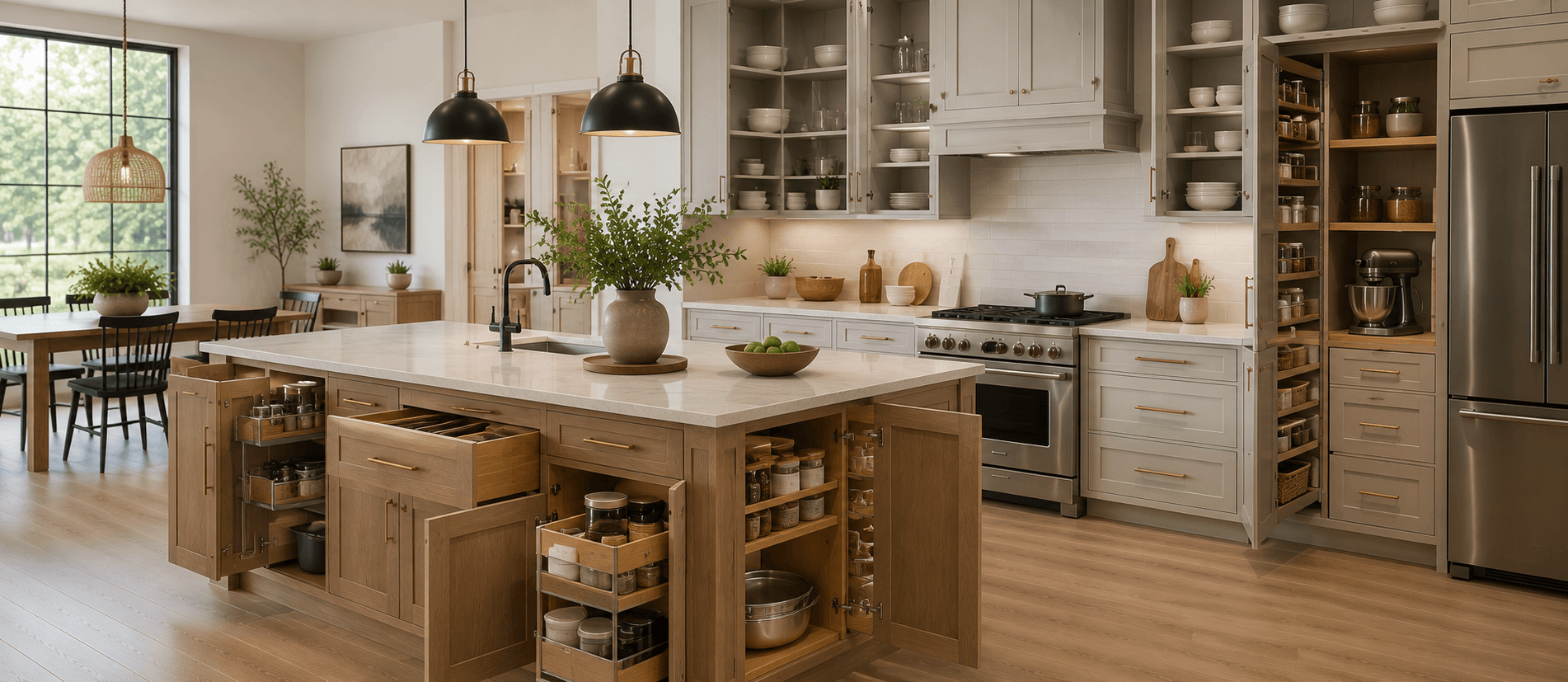
A kitchen renovation is a significant investment. Changing the cabinet color while recreating all the functional problems of the old kitchen is a missed opportunity.
At Walnor, this is why our design conversations aren't just about asking:
“What color cabinets do you want?”
We want to understand how you actually use your kitchen.
The goal should be to use the renovation to solve problems, not simply cover them with new cabinets.
Mistake #4: Being “Close Enough” With Measurements
A couple of inches might not sound significant.
Across an entire cabinet run, they can be.
Incorrect wall dimensions can affect fillers, cabinet clearances, corner cabinets, appliance openings and whether the proposed cabinet run fits at all.
This is why measuring your kitchen and checking the dimensions again against the final 2D design are both important.
We also provide local measurement services in select Southeast Michigan areas, including communities around Ann Arbor, Canton, Bloomfield and Novi.
Some homeowners prefer to have their contractor provide or verify measurements.
Regardless of how measurements are obtained, the customer should verify that the final dimensions, selected cabinets and approved design/quote are correct before placing the order.
Measure.
Design.
Then verify the design against the measurements again.
What Does a Kitchen Design Service Actually Do?
Buying cabinets isn't just choosing a door style and adding boxes to a cart.
A kitchen needs to work as a system.
• 2D kitchen layouts
• 3D renderings
• 360-degree viewing
• Itemized cabinet quotes
• Live 3D design assistance
• Cabinet style and finish guidance
• Layout recommendations based on how the customer uses the kitchen
The process typically starts with the customer sharing their kitchen measurements and inspiration.
Then we talk.
We want to understand what you like, but equally importantly, we want to understand how you use the space and what isn't working today.
From there, the kitchen can be designed collaboratively—including live 3D design sessions where changes can be discussed visually rather than trying to imagine everything from a cabinet list.
Whether you work with Walnor or another cabinet company, we strongly recommend seeing your proposed kitchen in a detailed design before ordering.
A cabinet list tells you what you're buying.
A design helps you understand the kitchen you're building.
Inspect Your Cabinets Before You Assemble Them
When an RTA order arrives, resist the temptation to immediately start building cabinets.
First, organize and inspect the shipment.
Confirm cabinet codes against your order and look for visible freight damage, missing components or manufacturing defects.
This isn't just theoretical advice. RTA suppliers commonly instruct customers to inspect products before assembly because assembling a damaged cabinet can complicate a damage claim.
Keep packaging until you've confirmed that the components are correct and undamaged, and follow the damage-reporting requirements provided with your specific order.
Then assemble according to the instructions for that cabinet line.
What About Cabinet Warranties?
Never assume “lifetime warranty” means every component is covered forever under every circumstance.
Ask what is covered and what is excluded.
Certain components may carry different warranty periods. Hardware such as glides, for example, may have shorter formal warranty coverage depending on the supplier.
Finish warranties also distinguish manufacturing defects from normal wear and tear, misuse or damage.
Always review the warranty applicable to the specific cabinet collection you're purchasing rather than relying solely on a general warranty statement.
A Simple RTA Cabinet Buying Checklist
Before ordering kitchen cabinets, you should be able to answer all of these questions:
• What is the cabinet box made from?
• How thick is the box material?
• Is the cabinet framed or frameless?
• Are the doors full overlay, partial overlay or inset?
• What are the drawer boxes made from?
• How are the drawer corners joined?
• Are the drawer glides full-extension?
• Are they undermount?
• Are drawers soft-close?
• Are door hinges soft-close?
• What are the doors made from?
• Have you seen an actual door sample?
• Have you viewed that sample inside your kitchen during different lighting conditions?
• Have you finalized your major appliances?
• Have you checked appliance specifications and clearances?
• Does the new layout solve the problems with your current kitchen?
• Have you reviewed a 2D or 3D representation of the final design?
• Have the wall dimensions been verified?
• Have window and door locations been measured?
• Have you checked the final design dimensions against the actual kitchen?
• If you're uncertain, has your installer or cabinet professional reviewed them?
• Are exposed cabinet sides finished, or do you need panels?
• Are fillers included where necessary?
• Are moldings and trim included?
• Do you understand the assembly system?
• Do you know the expected lead time?
• Have you reviewed the warranty?
• Are shipping and tax included in the quoted price?
If a cabinet seller can't clearly answer these questions, get the answers before placing the order.
So, Are RTA Kitchen Cabinets Worth It?
For many kitchens, yes—but the letters RTA aren't what make them worth buying.
The construction does.
A well-specified RTA cabinet can give homeowners plywood construction, solid-wood dovetail drawers, soft-close hardware and the style they want while avoiding some of the costs associated with other cabinet purchasing models.
But there are also RTA cabinets built to very different specifications.
That's why we recommend ignoring the label for a moment and comparing what you're actually getting.
Look at the box.
Open the drawer.
Check the joint.
Look underneath it.
Test the hinges.
Ask about the exposed sides.
Take the door sample home.
Measure the kitchen twice.
Finalize your appliances.
And make sure the new design actually fixes the things you dislike about your current kitchen.
Those decisions will have a much bigger impact on your finished kitchen than whether the cabinet arrived flat-packed or already assembled.
If your project requires highly specialized dimensions or customization outside the standard cabinet catalog, custom cabinetry may be the better route.
But if your kitchen can be designed successfully around standard cabinet configurations, quality RTA cabinetry is worth considering—regardless of the value of the home.
Planning a Kitchen in Southeast Michigan?
We offer free kitchen design with 2D layouts, 3D renderings and 360-degree views, along with live design assistance so you can understand the kitchen before ordering it.
Customers can also order real door samples to evaluate finishes inside their own homes, and local measurement service is available in select areas around Ann Arbor, Canton, Bloomfield, Novi and surrounding communities.
If you're starting a renovation, you don't need to know exactly which cabinets you need.
Start with your measurements, a few photos of your current kitchen, and what you want the new kitchen to do better.
That's enough to start designing.
Frequently Asked Questions About RTA Kitchen Cabinets
What does RTA mean in kitchen cabinets?
RTA means Ready to Assemble. The cabinet components are packaged unassembled and put together before installation. RTA describes the delivery and assembly format; it does not by itself describe the quality of the cabinet.
Are RTA cabinets good quality?
They can be. Quality varies substantially between cabinet lines. Instead of judging a cabinet simply because it is RTA, compare the box material, drawer construction, hardware, door material, finish, assembly system and warranty.
Are RTA cabinets made from plywood?
Some are and some aren't. RTA cabinets can use plywood, particleboard, MDF and other materials depending on the manufacturer and collection. Walnor's current cabinet collections use 1/2-inch plywood cabinet boxes with solid birch face frames.
Do RTA cabinets have soft-close doors and drawers?
Some do, but it isn't universal. Check the specifications before ordering. Walnor's current cabinet styles include soft-close hinges and soft-close, full-extension undermount drawer glides.
Are RTA cabinets cheaper than assembled cabinets?
RTA cabinetry can reduce costs associated with factory assembly and can be more compact for transportation and storage. However, the final price depends on construction quality, cabinet configuration, finish, accessories, shipping and who performs the assembly. Compare equivalent specifications rather than assuming every RTA cabinet will automatically be cheaper.
How long does it take to get RTA cabinets?
Lead times depend on the manufacturer, inventory and location. Walnor's general lead time for RTA/unassembled cabinet delivery is approximately 7 business days, while assembled orders generally take approximately 14 days. Actual timing can vary.
Can I assemble RTA cabinets myself?
Depending on the assembly system and your comfort level, many RTA cabinets can be assembled by homeowners, contractors or installers. Always follow the instructions for the specific cabinet line rather than assuming all RTA cabinets assemble the same way.
When should I choose custom cabinets instead of RTA?
Custom cabinetry becomes particularly useful when a kitchen requires dimensions, modifications, finishes or architectural details that aren't available within standard cabinet programs. If a kitchen can be designed effectively using standard cabinet configurations, RTA can remain an option even for higher-end projects.
How much does a 10×10 RTA kitchen cost?
It depends on the cabinet collection and exact configuration. As one real example, as of September 2026, a basic 10×10 Walnor kitchen in Haven Alpine White Shaker using the cabinet configuration described above is approximately $3,546 before shipping and tax. Different layouts and cabinet selections will produce different prices.
Recent Articles


RTA Kitchen Cabinets: What You Should Know Before Buying Them
Learn what to look for before buying RTA kitchen cabinets, from plywood construction and drawer quality to assembly, pricing, measurements, and common planning mistakes. This guide helps homeowners compare cabinets confidently and decide whether RTA is the right fit for their kitchen.
Read More